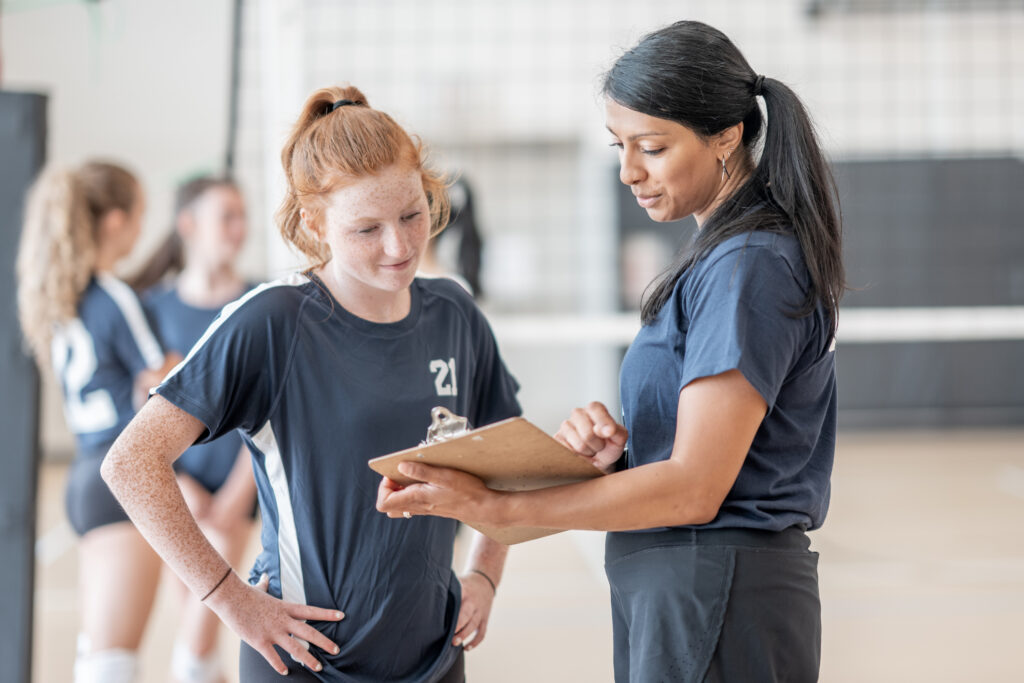
The Different Levels of College Volleyball

There are five levels of college volleyball: NCAA division I, II, and III, the NAIA, and junior college. Each one has its own roster caps, scholarship structure, and recruiting process. D1 women’s gets the TV time, but the opportunity to play in college is much wider than what you’ll see on ESPN in the fall.
Let’s take a look at some of the nuances of each level of indoor college volleyball.
NCAA Division I
D1 volleyball is what you see on the marquee—it’s the highest level. The power 4 conferences—SEC, big ten, ACC, big 12—get most of the national coverage, and programs like texas, nebraska, penn state, and stanford fill the polls and the NCAA tournament brackets each fall. Across all of D1 there are 344 programs.
A few things to know:
- Roster cap of 18, scholarships up to 12. Programs can offer full or partial scholarships across the entire roster.
- Year-round commitment. Practice, lifting, conditioning, travel, and academic load run from august through may, with the heaviest schedule in the fall. It’s a genuine, full-time job.
- Recruiting is intense. Programs evaluate hundreds of recruits each cycle for a handful of openings. The athletes who land there have usually been on coaches’ radars for years.
If D1 is the goal, your development arc, measurables, and club team visibility all need to match the level.
NCAA Division II
D2 volleyball is very competitive, and played at smaller schools with a stronger academic-athletic balance than the D1 level.
A few things to know:
- Equivalency scholarships. D2 women’s has 8 scholarship equivalencies; D2 men’s has 4.5. Aid is split as full or partial across the roster, often combined with academic and need-based aid for a stronger overall package.
- Recruiting rules are more flexible than D1. Timelines are less rigid, and relationships with coaches can develop more naturally throughout high school.
- The competition is legit. D2 rosters are full of athletes who could play at higher levels but opted for fit and a less-demanding athletic obligation.
A D2 program where you start, contribute, and grow is a much better outcome than a D1 program where you never see the court.
NCAA Division III
D3 is the largest division in NCAA volleyball, with hundreds of programs spread across academic institutions of every size and type. The competition is legit, the schools are diverse, and the path is one of the most underrated in the sport.
A few things to keep in mind:
- No athletic scholarships. Financial aid comes from academic and need-based sources, which can be substantial at the right school.
- Tons of programs. Hundreds of D3 volleyball programs nationwide give athletes serious geographic and academic flexibility.
- Fit above all. D3 coaches recruit heavily for culture, academic match, and long-term commitment. The campus and the academic experience are the foreground.
For athletes who love volleyball and want a full college experience academically, socially, and athletically, D3 deserves serious consideration.
NAIA
The NAIA operates outside the NCAA. Most NAIA volleyball programs are at smaller schools, which are often religiously affiliated or liberal arts-focused, with strong athletic departments and a tight-knit campus feel.
A few things to know:
- Athletic scholarships available. Aid varies significantly by school but is available at most programs.
- Fewer recruiting restrictions. Coaches can communicate with athletes earlier and more directly than NCAA programs, which often leads to more natural relationships.
- Smaller campuses, smaller class sizes. NAIA schools tend to feel close-knit, with a stronger student-athlete experience than giant, 20,000+ enrollment schools.
NAIA is a legitimate option for athletes who want to compete, earn athletic aid, and find a school that fits their size preference and academic goals.
JUCO
Junior college volleyball, organized through the NJCAA nationally and the cccaa in california, is a two-year springboard for athletes who want time to develop before committing to a four-year program. Many D1, D2, and NAIA roster spots get filled by JUCO transfers each cycle.
A few things to know:
- Athletic scholarships at the higher levels. NJCAA division I and II programs offer aid; NJCAA division III does not.
- Time to develop. JUCO can offer two years to grow physically, academically, and athletically before transferring up.
- Direct pipelines. Many JUCO programs have direct relationships with four-year programs across the country.
For athletes who aren’t ready for a four-year commitment out of high school, or who want a stronger pre-transfer profile, JUCO is a real path forward.
The vast majority of high school volleyball players who go on to play in college find their path somewhere outside the power 4. It’s a legitimate path that provides the opportunity to continue a volleyball career and get a great education.
Locking in on D1 volleyball as the only path forward closes off most of the actual opportunity. An athlete who plays meaningful minutes, develops in a system that fits, and feels at home on their team has a far better four years than one who reaches a higher division and never sees the court.
Remember, volleyball seasons are short—only a few months a year. The four-year college experience extends well beyond the gym. The school you commit to is where you’ll live, study, eat, sleep, and build the rest of your life for those four years. Don’t forget about the time you’ll spend not playing volleyball.
How most of college volleyball actually plays out
The vast majority of high school volleyball players who go on to play in college find their path somewhere outside the power 4. It’s a legitimate path that provides the opportunity to continue a volleyball career and get a great education.
Locking in on D1 volleyball as the only path forward closes off most of the actual opportunity. An athlete who plays meaningful minutes, develops in a system that fits, and feels at home on their team has a far better four years than one who reaches a higher division and never sees the court.
Remember, volleyball seasons are short—only a few months a year. The four-year college experience extends well beyond the gym. The school you commit to is where you’ll live, study, eat, sleep, and build the rest of your life for those four years. Don’t forget about the time you’ll spend not playing volleyball.
Final thoughts: College volleyball is a layered landscape with real opportunity at every layer. The athletes who land somewhere they thrive aren’t always the most decorated—they’re the ones who understood the differences and picked accordingly.