What College Football Coaches Actually Evaluate
Understanding what coaches look for is the single biggest advantage a recruit can have. It shifts the mindset from “how do I get noticed” to “how do I become exactly what a program needs.”
Coaches aren’t just looking for the most talented player available. They’re building a roster—filling specific roles, in specific schemes, for specific class years. Here’s what they’re actually evaluating when they watch you play.
Athletic ability
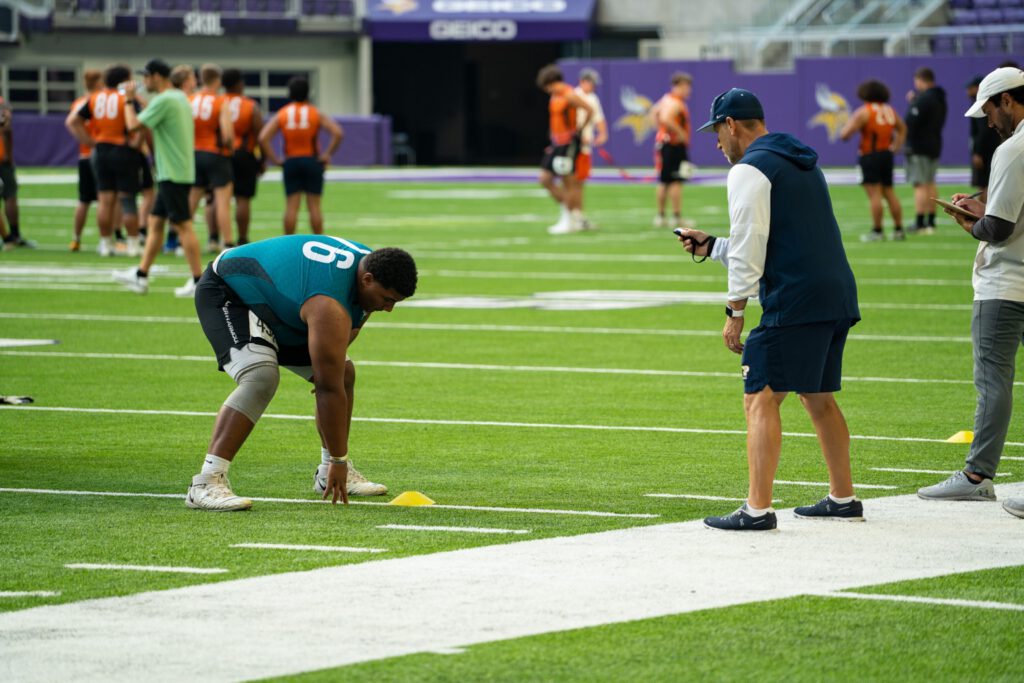
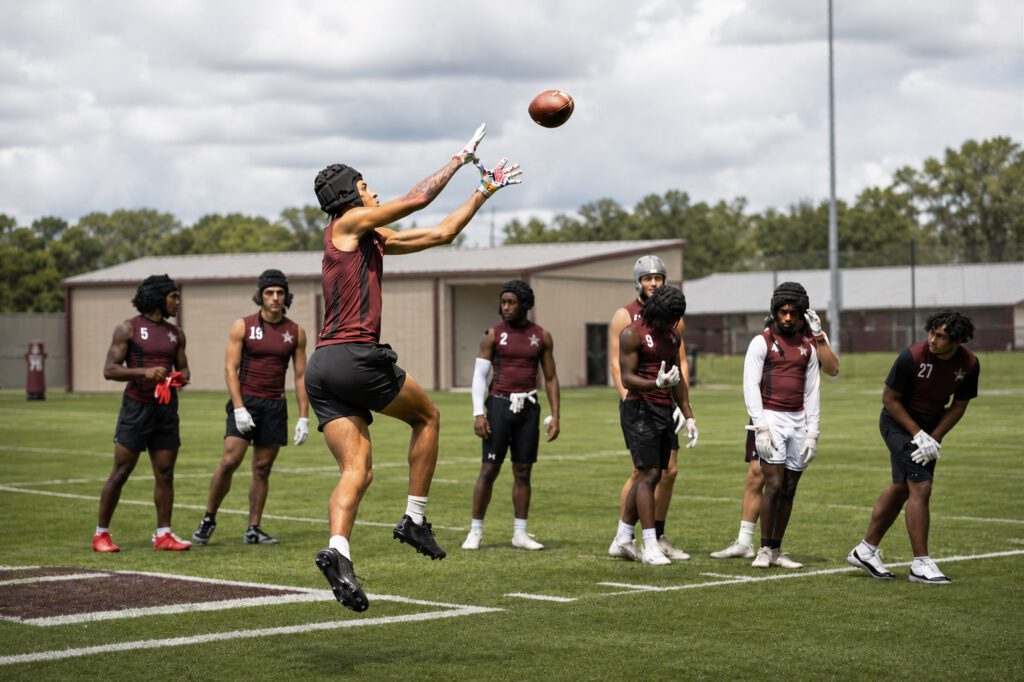
Raw athleticism is usually the first thing that gets a coach’s attention. Speed, strength, explosiveness, and agility are how recruiting staff compare players across programs and levels. It’s what gets your foot in the door.
But athleticism only tells part of the story. What coaches are really evaluating is how your athleticism translates to football—and to their system specifically. A 4.6 forty is solid for a running back. For a linebacker, it’s elite. Context matters, and understanding the benchmarks for your position at the levels you’re targeting is essential before you walk into a camp.
Beyond the measurables, coaches are watching for something harder to quantify—the innate physical tools that signal a high ceiling.
They are looking to see:
- How naturally you move and change direction
- Your fluidity and flexibility in space
- How you process and react to what’s happening around you at full speed
- Whether your athleticism translates across situations, not just in a straight line
These qualities tell a coach you can be developed, that your athleticism is transferable, and that your best football might still be ahead of you.
Which leads to something worth knowing early: your high school position may not be your college position. Coaches see athleticism first and position second. Wide receivers become defensive backs. Quarterbacks become safeties. Tight ends become linebackers. It happens at every level, every year.
The athletes who stay open to positional changes—and trust that coaches are seeing something real—often end up finding a better fit than they ever expected.
Physique and size
Size matters in football, but how much depends entirely on the position and the level.
A Power 4 offensive lineman needs to be 300+ pounds. A D3 lineman can do well at 260. A D1 cornerback needs an elite vertical and speed. At the NAIA level, athleticism and football IQ can offset physical limitations that would close doors at the FBS or FCS level. Know the typical size and measurable ranges for your position at the levels you’re realistically targeting—not to discourage yourself, but to help you focus your energy in the right places.
What you can’t control is your genetics. What you can control is your physical development. Train consistently, eat and sleep like an athlete, and be patient with the process. Athletes who invest early often show the most dramatic physical growth by senior year—and coaches see it.
Game performance
Coaches need to know if you can compete when it matters. Film, measurables, and camp performances all contribute—but watching you play in a real game, against real competition, carries more weight than any of it.
What coaches evaluate goes well beyond your highlight reel. They want to see how you perform across a full game, a full season, and against the best competition on your schedule. They’re watching how you respond to adversity—how you come back after a bad series, a turnover, a missed assignment. Athletes who compete hard, stay locked in, and bounce back always stand out. Coaches notice when you don’t.
A few things worth keeping in mind:
- Consistency matters more than peaks. Everyone has a bad game once in a while. Coaches recruit over the course of your career, not a single performance.
- Seek out the best competition you can. Playing in stronger leagues and higher-level showcases is one of the best things you can do for your development and your recruitment.
- Every game is an opportunity. You never know who’s in the stands or watching film. Compete hard every single time.
Football IQ
Football IQ is the ability to read the game as it unfolds—to anticipate what’s coming, process it fast, and make the right decision under pressure. At the college level, it’s one of the most valuable things a recruit can have.
It’s the linebacker who reads the play before the snap. The cornerback who jumps the route because he recognized the formation. The offensive lineman who makes the right protection call in a fourth-quarter blitz. These athletes make everyone around them better—and coaches actively recruit for it.
The good news: football IQ is developable. A few ways to build it:
- Study film—yours and the pros’. Watch how elite players at your position move, make decisions, and anticipate before, during, and after the play.
- Ask your coaches why. Understanding the reasoning behind scheme decisions accelerates learning faster than repetition alone.
- Play with intention. Every practice rep is a chance to sharpen your reads and decision-making—don’t just go through the motions.
Talent gets you on a coach’s radar. Football IQ is what keeps you there.
Character and coachability
Every skill covered above counts, but character, attitude, and how you carry yourself on and off the field count most.
A coach who offers you a roster spot is committing several years to a person, not just a player. They want to know you’ll arrive ready every day, take coaching well, own your mistakes, and lift the teammates around you. A program is only as strong as its culture, and coaches guard theirs closely.
Your reputation also reaches coaches before you do. They talk with your high school coaches, your position coaches, and people in your community. How you treat teammates, opponents, and everyone else day to day shapes the impression a coach forms of you well before your first conversation.
Here are three habits worth building:
- Stay coachable. Take feedback well and truly want to improve. Coaches recruit athletes they can develop, and that depends on being open to coaching.
- Be a strong teammate. The athletes who get recruited aren’t always the stars. They’re often the ones everybody wants on their team.
- Stay consistent. Be on time, follow through on what you say you’ll do, and act the right way when nobody is watching.
Athletic ability can be developed over time. A reputation as a great teammate and a good person is what coaches bet on first—and that’s entirely in your hands.
Final thoughts: Coaches aren’t evaluating one thing—they’re evaluating everything. The athletes who get recruited are the ones who keep developing physically, sharpen their football IQ, show up with the right attitude, and build real relationships over time. No single quality wins the day. All of them together do.