Film, Camps, and Exposure: What Actually Gets You Noticed in Basketball
Getting in front of college coaches takes deliberate work. Your film, the camps you choose, the events you compete in, and your high school season all affect how coaches see you. If you want to maximize your exposure, make sure you prioritize all of them.
Your film
Having film is imperative. It’s how you get in front of college coaches and recruiting staff anywhere in the world, and it’s the part of recruiting you have the most direct control over.
In basketball, film is made up of three different types of video assets:
A highlight reel is the clean, recruiting-focused version coaches evaluate from—plays selected to show your skills, no music.
A mixtape is essentially your highlight reel, usually edited with dramatic cuts and accompanied by hip-hop or electronic music—you can see them all over social media and YouTube.
Full game film is the long-form footage coaches use to see how you operate across a full game.
Mixtapes can be extremely fun and a great way to stretch your creative muscle on social media. But the reality is that most college coaches aren’t one awesome mixtape away from finalizing their roster—the film they actually evaluate from is the highlight reel and full game film.
Here’s what each one should look like:
- Keep your highlights tight. Three to five minutes is the right length, with 15 to 25 plays maximum. Lead with your best play—coaches decide within the first minute whether to keep watching.
- Identify yourself in every clip. Use a simple circle or arrow that appears before the play starts and disappears as the play begins. Don’t make a coach guess which player on the court is you.
- Open with a title slide. Your title slide should include your name, grad year, position, height, weight, GPA, and contact info. The goal is to make it easy for a coach to know exactly who they’re watching within the first three seconds.
- Use Hudl if your school or club already does. Hudl is the default platform in basketball recruiting. It lets you share footage directly with coaches and keep your profile current as the season unfolds.
Full game film matters even more than the highlight reel. Highlights show your best moments. Full games show how you operate when nothing’s going right, when the defense is set, and when you aren’t shooting well. Coaches recruit based on what you do across full games, not just the highlights.
What basketball film should look like
Basketball film is all about rhythm. Coaches watch for flow—multiple-possession stretches that show how you function within an offense and a defense. A clip of you operating across a half is more useful than 20 isolated clips of you scoring.
What coaches want to see:
- Your game in context, not isolated plays. Coaches want to see possessions strung together—how you transition from offense to defense, how you respond to a turnover the next time down the floor.
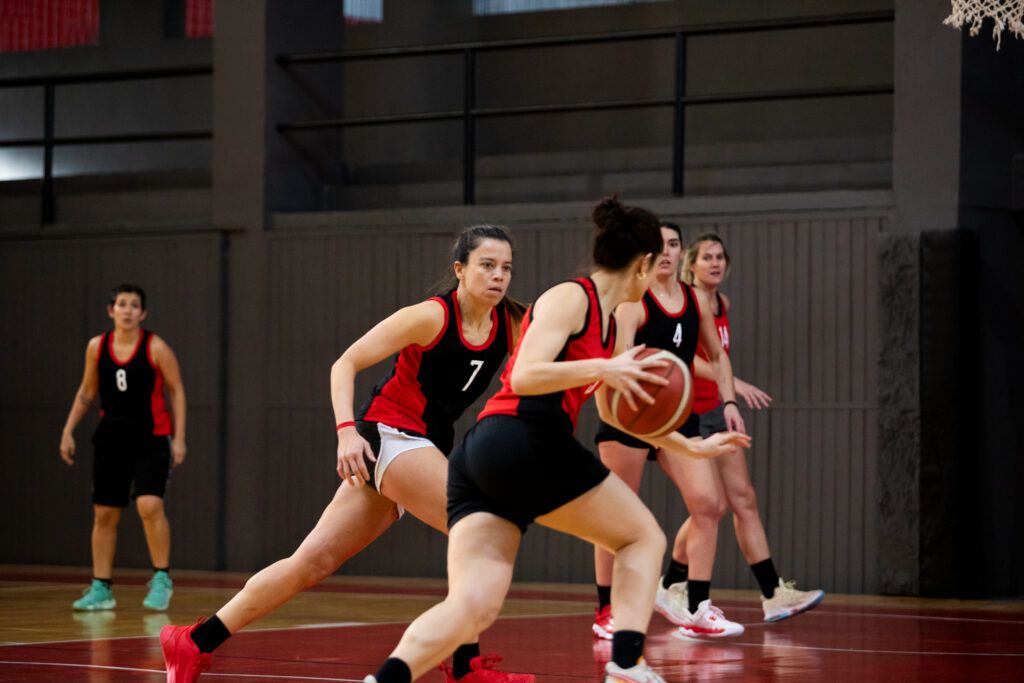
- Show what you do without the ball. In modern basketball, the 80% of the game when the ball isn’t in your hands matters as much as the 20% when it is. Cuts, screens, and off-ball movement all need to show up in good film.
- Include defensive clips. Coaches want to see you on the defensive end—closeouts, rotations, recovery, talking, and work rate. Defensive film is often what separates two similar offensive prospects.
The athletes who include defensive possessions and full-flow stretches in their film communicate that they understand the game. Coaches read that as basketball IQ—something they’re always looking for.
Know your measurables
Coaches want to see concrete numbers next to your name. Vertical, lane agility, sprint times, wingspan—these are the measurables coaches use to compare athletes across programs and positions.
What to know:
- Vertical leap (standing and approach). Standing vertical matters for rebounding and defensive contesting at the rim. Approach vertical matters for finishing through contact and dunking.
- Lane agility. Lane agility measures how quickly you change direction at full speed. It reads as switchability defensively and separation off the dribble offensively.
- Three-quarter-court sprint. This measures top-end speed across a basketball-specific distance.
- Wingspan and standing reach. Wingspan often outweighs raw height in coaches’ eyes. Standing reach determines your defensive ceiling at the rim.
- Know your numbers before walking into camp. Camps will test your measurables and verify them against what you’ve reported. Coaches notice when stated numbers and tested numbers match up.
Position-specific benchmarks matter more than raw athleticism. A 6’2″ guard with a 36-inch vertical is graded differently than a 6’9″ wing with the same vertical. Know your numbers, know the benchmarks for your position at the levels you’re targeting, and use the gap as a roadmap for what to develop.
Camps for college basketball recruiting
Camps are one of the most direct ways to get evaluated by a college program’s coaching staff. They’re also one of the most misunderstood—not every camp serves the same purpose, and not every camp is worth the cost.
The main types of camps in basketball:
- Elite or individual camps run by college programs. These are hosted on a specific college campus and run by that program’s coaching staff. If you’re seriously interested in a school, attending their camp is one of the most direct ways to get on their radar.
- Team camps. Team camps bring AAU or high school teams to compete against other teams at a college campus over a few days. They’re good for exposure and for seeing how you stack up against competition you might not otherwise face.
- Position camps. Position camps focus on a single skill set—shooting, post play, guard skills. They’re good for development and for being evaluated in a focused environment.
- Skills academies and combines. Invitational events like Pangos camps, NBPA Top 100, USA Basketball events, and women’s equivalents are smaller, invitation-only, and heavily attended by college coaches.
A camp at a program where you actually fit—academically, athletically, geographically—is one of the highest-leverage things you can do in recruiting.
Summer showcases and tournaments
Summer is the busiest stretch of the basketball recruiting calendar, and getting in front of coaches during this window takes planning. From April through July, college coaches travel to AAU events to evaluate hundreds of prospects across compressed weekends. The athletes who plan their summer deliberately end up with the most options.
How to think about summer events:
- NCAA-certified live periods. These are the specific weekends in April and July when D1 coaches are allowed to attend AAU events. They’re the highest-leverage exposure weekends in basketball.
- Major summer tournaments and events. Peach Jam, Fab 48, adidas Gauntlet, EYBL Finals, and others all draw heavy coach attendance—including some outside the NCAA-certified weekends.
- Regional summer tournaments matter for non-high-major recruiting. For D2, D3, NAIA, and JUCO programs, regional summer events draw the coaches who recruit at those levels. The high-major circuits aren’t the only path.
- Email coaches before the event. Coaches plan their summer travel weeks in advance. If you want a specific coach to see you, email them with your team, your jersey number, and your game schedule.
- Look for showcases attached to major tournaments. Many major events run satellite showcases the night before the main bracket. These attract heavy coach attendance and are worth participating in when they’re available.
Summer is also exhausting. Athletes who burn out by July have left the most important weekends on the table. Pacing yourself across the summer—and showing up the same way on the second weekend as the first—is part of the work.
In-season evaluation
The summer drives recruiting, but the high school season matters too. From November through February, coaches can attend high school games during NCAA evaluation periods. For programs below high-major D1, high school season often carries more weight than the summer circuit.
What in-season recruiting looks like:
- High school season shows coaches how you function within a team. Summer AAU shows skills against equivalent talent. High school season shows whether you make your teammates better, whether you handle the role you’re given, whether you compete in a tougher schedule night after night.
- For D2, D3, NAIA, and JUCO recruiting, high school season carries more weight than the summer. Coaches at those programs often build their recruiting boards from high school film and games more than from AAU events.
- Coaches can attend high school games during NCAA evaluation periods. The specific windows shift each season—keep your film updated and let coaches know your schedule.
- Keep your film current throughout the season. Coaches who saw you in July want to see what you look like in January. Updated film tells the story of your development.
- Send coaches your high school schedule. If you’re in active conversations with college programs, send them your high school schedule. Make it easy for them to come see you.
In-season is typically quieter than the summer, but the college basketball recruiting process doesn’t stop. Coaches who saw you in July are tracking what you do in November and December. The athletes who treat high school season like part of recruiting—not separate from it—give themselves a fuller picture.
Final thoughts: Film, camps, summer events, and high school season each show coaches a different version of you. Film is the introduction. Camps are the direct evaluation. Summer is the heaviest recruiting window. High school season is where coaches see you within a team. The athletes who use all four deliberately—and who treat each one as part of the same recruiting picture—give coaches every chance to see who they are.